

The U.S. Tire Manufacturers Association released our 2025 End-of-Life Tire Market Report on October 27, 2026. The Association has published the report roughly every two years since the early 1990s, yielding more than three decades of data on end-of-life tire generation, markets and stockpiles. It is the most comprehensive national reporting available.
Our Vision for Sustainability in Tire Manufacturing
USTMA members share a common vision on sustainability which includes: Promoting tire safety; advancing worker safety; reducing greenhouse gas emissions throughout a tire’s useful life; improving environmental footprints over time; minimizing the health, and environmental impacts of tire materials; and ensuring end-of-life tires enter sustainable markets.
Specifically, USTMA members share the goal that all ELTs enter sustainable and circular end-use markets.
METHODOLOGY & MATERIALS
How We Compile the ELT Market Data
What is an ELT?
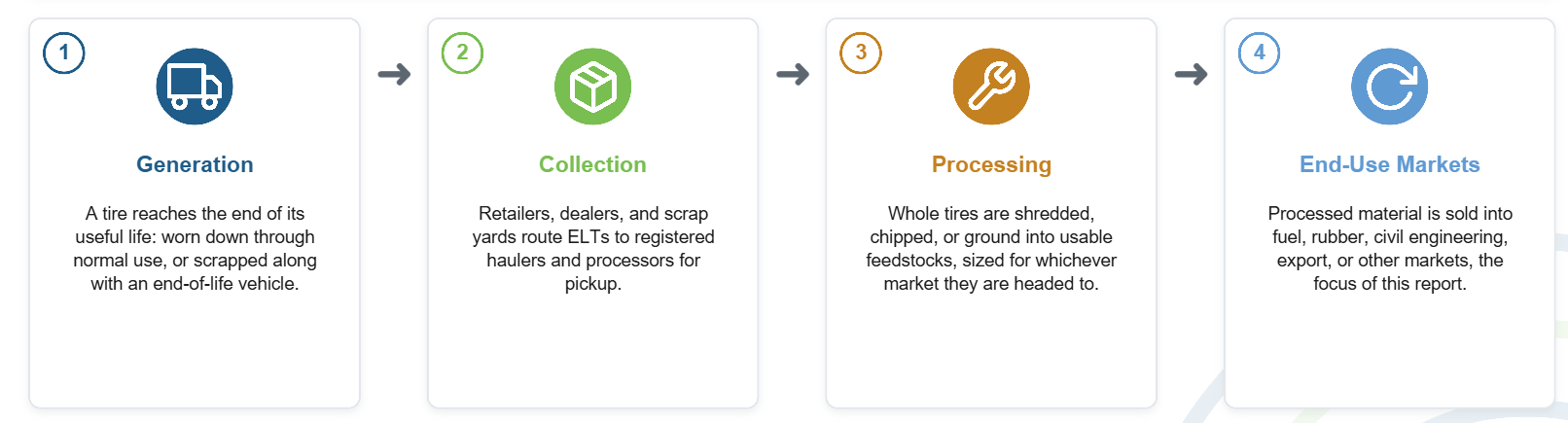
An end-of-life tire (ELT) is a tire that can no longer serve its original purpose on a vehicle, typically because its tread has worn down, the tire was damaged by a road hazard, or because it was scrapped along with an end-of-life vehicle. ELTs are a normal, predictable byproduct of tire use. This report tracks what happens to them in the U.S. once they are generated.
2025 at a Glance
In 2025, about 79% of the 273 million end-of-life tires generated in the United States reached end-use markets.

This was a dynamic year: stockpile cleanup kept delivering, markets moved in both directions, and exports rose. What this year’s figures do not yet reflect is the market-development work already underway that is expected to grow domestic markets over the next 12 to 24 months.
U.S. End-of-Life Tire Generation by Source, 2025
In 2025, 273 million tires were generated, that is 5,154K tons.
Light duty dominates: Light-duty tires make up 87% of gross tires hauled (274M of 316M), which nets to 273M once used-tire culls are subtracted. Commercial tires are far heavier per unit, though: 120 lbs vs. 25 lbs for light-duty.

U.S. End-of-Life Tire Generation, 2017–2025
In 2025, 273 million tires were generated, 5,154K tons, up 9.5% from 249.4M tires in 2017 (~3%/year), tracking more miles driven.
86.6% light duty: Passenger + light truck + scrapped-vehicle tires; steady since 2017 (88.6%).
COVID dip fully reversed: Generation fell sharply in 2020-21 as pandemic-era driving dropped; by 2025, it has run 9.5% past 2017 levels.
From 2023 to 2025, vehicle miles traveled rose about 1.8% (3,264 to 3,324 billion) while regular gasoline fell from $3.52 to $3.10 per gallon.
Bold total above each column is net of used tires culled for resale (each report’s reconciled generation figure); gross tires hauled shown in parentheses.
What the Five Markets Mean

Where End-of-Life Tires Went, 2025
Share of the 5,154 thousand tons of end-of-life tires generated in 2025, by market. Hover or tap a slice for details.

Market Mix & Utilization Trends, 2017–2025
Thousand tons of end-of-life tires by market in each report year. Hover or tap a segment for details.
The biggest swing since 2023.
Tire-derived aggregate vs. 2023: 264K down to 207K tons.
Essentially flat vs. 2023.
Exports and domestic markets. Overseas demand grew sharply this cycle, which shows the material has real value. USTMA’s priority is to keep more of that value at home. Domestic markets used less material than in 2023, and growing them is a focus of USTMA’s market-development work.
A Market in Transition
Tire-derived fuel remains the largest single market at about 1,317 thousand tons, followed by ground rubber at about 1,201 thousand tons. Cement kilns grew about 5% to 821 thousand tons, now 62% of tire-derived fuel, as CO₂-reduction pressure and tire-derived fuel's biogenic content make it an attractive alternative fuel. Reclamation projects grew about 10%.
Download the full report for a detailed breakdown of the various sub-markets.
Tire Beneficial Use vs. Other Materials
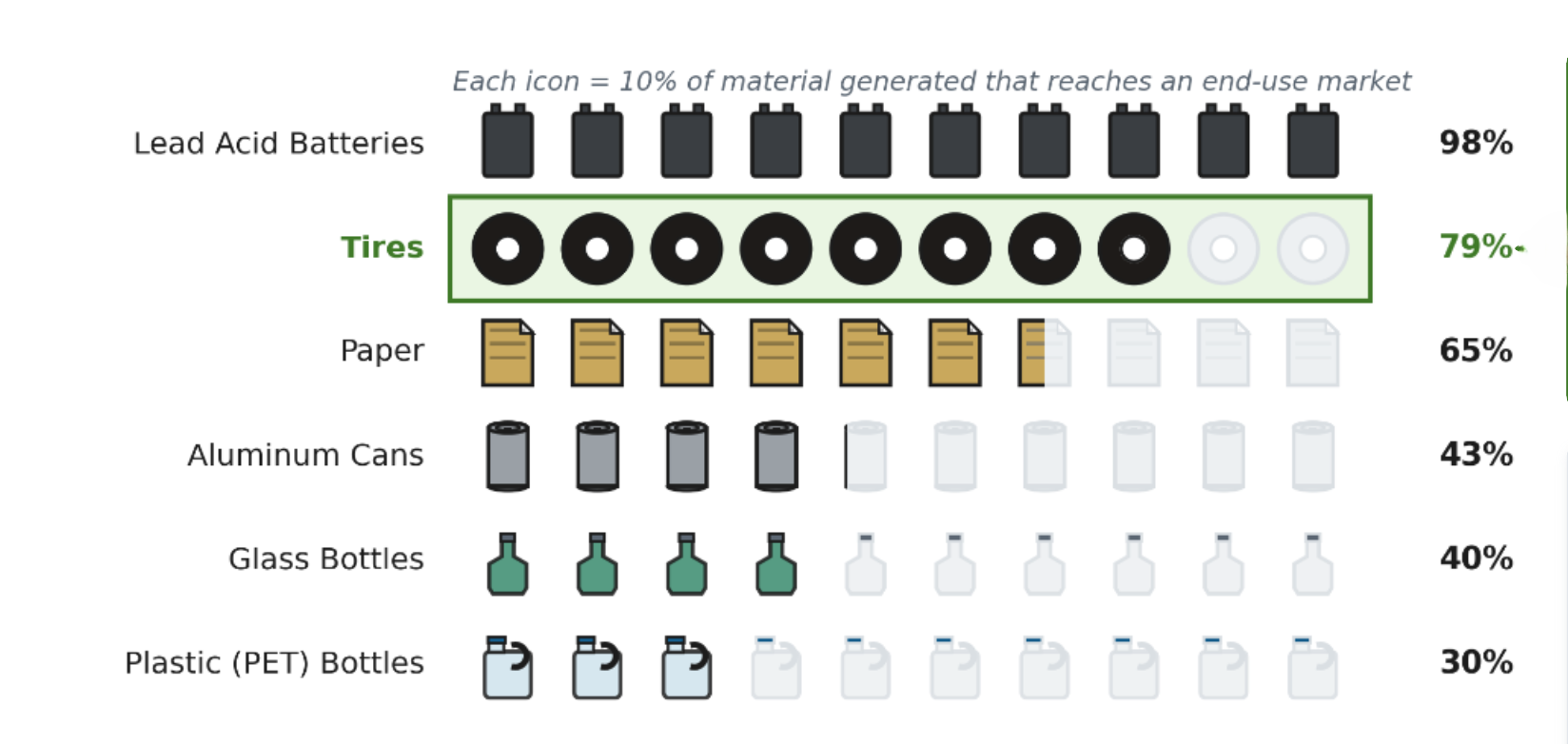
Tires remain the second-most recycled and reclaimed material after lead-acid batteries – ahead of paper, aluminum, glass and PET plastic – keeping valuable materials in circulation rather than sending them to landfills.
Stockpiles Fell 12% in Two Years.
Nationally, illegal and abandoned stockpiles fell to approximately 42.1 million tires, down from about 48 million in USTMA's 2023 report – a 12% decline in just the last two years and a 96% reduction from the billion-tire peak in 1990.
No states currently fall in the 5–10 million or over-20 million tire stockpile categories. Shows current stockpile size, not direction of change. Hover or tap a state for its exact count. Source: USTMA’s state-by-state tracker, dated October 2026.
THE LONG CLEANUP
U.S. Stockpiled Tires, 1990–2025
*1998 is a Rubber Manufacturers Association estimate, not measured data. Dashed line is an exponential-fit trendline, not a reported figure.
Its cleanup program drove the entire net decline.
48M → 42M, even as state reporting continues to improve.
From the 1-billion-tire peak in 1990: a genuine success story.
2025 in Review: Key Takeaways
Markets roughly kept pace with generation: In total, markets consumed 79% of end-of-life tires in 2025, essentially flat vs. 2023, as export growth helped offset softening in traditional domestic markets.
Exports are offsetting the decline: Growth in exports kept pace with declines in traditional ELT markets, while pyrolysis is making a growing impact on ELT management.
TDF expect continued fluctuation: Tire-derived fuel markets are expected to continue fluctuating with energy pricing and climate and environmental policy.
Ground rubber: broad-based softening: Every ground-rubber sub-market pulled back since 2023 -- Molded & Extruded/Automotive most of all (-13.1%) -- reflecting softening across ground-rubber markets.
Asphalt and aggregate: market opportunities: Rubber-modified asphalt (RMA) declined from 165K tons in 2023 to 157K in 2025, and tire-derived aggregate (TDA) from 264K to 207K. New infrastructure funding and state road specifications could help both grow, but 2025 does not show that yet.
GROWING DOMESTIC END-USE MARKETS
Looking Ahead to 2027: Market Priorities
Effective state programs
USTMA promotes state ELT programs that combine dedicated funding, market development, and provisions to manage, abate, and deter illegal dumping.
Infrastructure markets
New infrastructure funding and state road specifications that call for tire-derived materials could grow RMA and TDA, including through expanded chip seal and the RMA dry process.
Environmental performance
The Tire Recycling Foundation (TRF), a nonprofit focused on achieving 100% circularity for ELTs, is funding environmental product declarations (EPDs) that give specifiers verified lifecycle documentation, and developing lifecycle assessments.
Research
State of Knowledge reports for rubber-modified asphalt and tire-derived aggregate close data gaps and support new specifications. USTMA released the TDA report in 2025 and expects an updated RMA report by the end of 2026.
New markets
Pyrolysis, which heats shredded tires in a low-oxygen chamber to recover oil, gas, and a carbon-black substitute, was broken out as its own market in 2025 (56K tons, about 1% of generation).
Keeping value at home
Overseas demand shows the material has real value. A tire processed in the United States supports a U.S. recycler, U.S. jobs, and U.S. infrastructure.
These investments are not yet reflected in the 2025 figures. USTMA expects their impact within 12 to 24 months; this report is the baseline against which that work will be measured.
Hear from Our Experts on the 2025 Report

Webinar recording coming soon.
USTMA's End-of-Life Tire Program
USTMA began its end-of-life tire program in 1990 under the auspices of the Scrap Tire Management Council. USTMA works with all stakeholders, including states, U.S. EPA and the industry to develop markets, reduce end-of-life tire (ELT) stockpiles and implement state regulations that that foster sustainable ELT tire markets. USTMA supports sustainable and circular ELT markets.
Dashboard
Over 30 years' worth of data:
Interact with the ELT dashboard, where you will find data from all previous reports dating back to 1990.
Previous Reports
Our Partners
Tire Industry Project (TIP)
USTMA is working with our global partners, including the Tire Industry Project to better understand global end-of-life tire (ELT) management and improve data availability and quality across countries and regions.

Visit the TIP's Tire Recycling Data Map, a significant step toward establishing a more comprehensive reference of global ELT management. By consolidating information in an interactive, visual map, it provides an easy-to-use resource for understanding how ELTs are managed across different geographies.
The Tire Recycling Foundation
Learn how USTMA & partners are working toward the goal of 100% of end-of-life tires entering sustainable and circular end-use markets.
Frequently Asked Questions
What is the End-of-Life Tire Market Report?
The End-of-Life Tire Market Report is USTMA's biennial assessment of where America's end-of-life tires go once they leave the road. The association and its predecessor organizations have published it roughly every two years since the early 1990s, which gives it more than three decades of consistent data on scrap tire generation, markets and stockpiles. It is the most comprehensive national picture of this material available.
What is an end-of-life tire?
An end-of-life tire, or ELT, is a passenger, light truck, or truck and bus radial tire that has reached the end of its operational life and can no longer serve its original purpose, whether through worn tread, road damage, or because the vehicle it was on was scrapped. End-of-life tires are a normal and predictable byproduct of tire use.
Why does USTMA call this a market report rather than a recycling report?
This report provides information on all economically viable and environmentally beneficial end uses of ELTs, including energy recovery and land reclamation, beyond energy reclamation and recycling applications. Moreover, because end-of-life tire markets are demand-pull, not supply-push tracking market health rather than volume of tires generated is the more accurate measure of whether the system is working, and it points to where investment is needed.
How is the data collected?
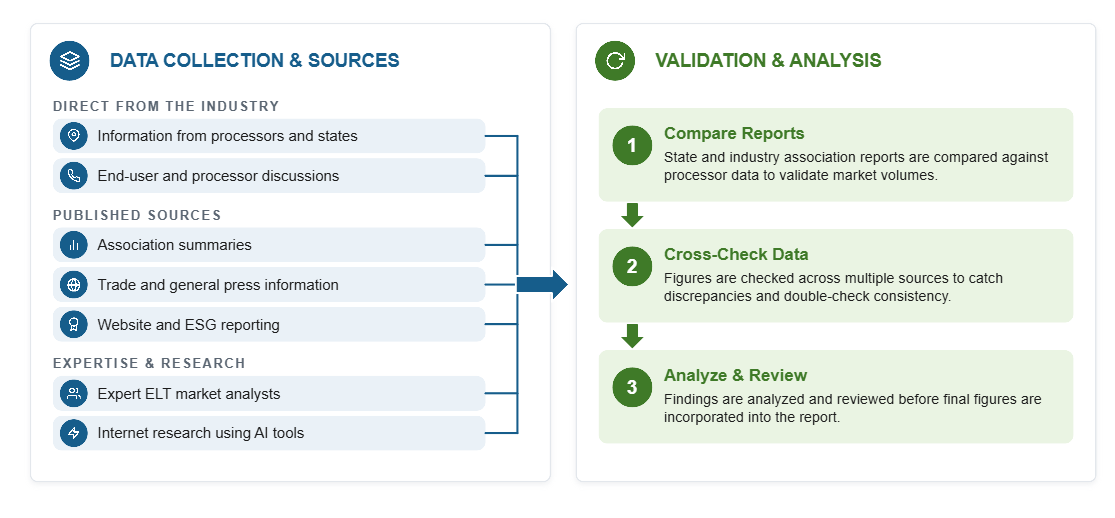
USTMA compiles the report from direct submissions by states and processors, association summaries, trade and general press, discussions with end users and processors, ESG reporting, and consultation with expert market analysts. Every figure is compared across state and industry reports, cross-checked against processor data, and reviewed before it is finalized.
What are the headline numbers for 2025?
The United States generated about 273 million end-of-life tires, roughly 5,154 thousand tons. About 79% reached end-use markets. Nationally, illegal and abandoned stockpiles fell to approximately 42.1 million tires, with a 12% reduction of stockpiles in just the last two years. Exports grew sharply and are now the third-largest destination for U.S. end-of-life tires.
How do tires compare with other recycled and reclaimed materials?
Among the materials benchmarked in this report, end-of-life tires are recycled and recovered at a higher rate than any consumer material except lead-acid batteries, keeping valuable materials in circulation rather than sending them to landfills. This is well ahead of other materials such as paper, aluminum, glass, and PET plastic.
What are the largest end-use markets?
Tire-derived fuel remains the largest single market at about 1,317 thousand tons, used primarily in cement kilns, pulp and paper mills, and electric and utility boilers. Ground rubber is second at about 1,201 thousand tons, supporting molded and extruded products, recreation surfaces, sports surfaces and rubber-modified asphalt. Tire-derived aggregate, used in civil engineering fill and drainage, is third among domestic markets.
Which markets grew in 2025?
Cement kilns grew about 5%, to 821 thousand tons, as pressure to reduce CO₂ emissions made tire-derived fuel an attractive alternative fuel since part of its carbon comes from natural rubber, which is plant-based. Reclamation projects grew about 10%. Pyrolysis crossed 1% of generation for the first time and is broken out as its own category in this report.
Which markets declined, and why?
Several markets contracted for reasons largely outside the tire industry's control. Within tire-derived fuel, mill closures cut pulp and paper's consumption about 40%, and Michigan energy law changes reduced electric and utility boiler volume about 22%. Within ground rubber, synthetic turf continues to lose share to alternative infill materials such as cork, coconut husk and olive pits, and molded and extruded products pulled back from an unusually strong 2021 peak. Broader energy market volatility has also affected tire-derived fuel economics relative to conventional fuels.
What is pyrolysis, and why does it appear as a new category?
Pyrolysis heats shredded tires in a low-oxygen chamber to recover oil, gas and a carbon black substitute. It has reached enough domestic volume, about 56 thousand tons, to be measured and reported on its own for the first time. It remains about 1% of generation, but it is a market USTMA expects to continue growing.
How much progress has been made on tire stockpiles?
Nationally, illegal and abandoned stockpiles have fallen from roughly one billion tires at its 1990 peak to about 42.1 million today, a 96% cumulative reduction. Stockpiles declined 12% in the last two years alone. It is one of the largest post-consumer cleanup efforts in U.S. history.
What drove the most recent reduction in stockpile?
Colorado's cleanup program accounted for the largest single reduction, drawing its reported stockpile down from about 26.2 million tires to 14.05 million. New Jersey and Pennsylvania also reduced their stockpiles substantially, and North Carolina, Tennessee and Delaware fully resolved theirs.
Why do some states show increases in stockpile?
Some increases reflect improved state reporting rather than new tires accumulating. Several states moved from not reporting any data to reporting a measured figure, which registers as an increase even though the material was already there. USTMA views better state-level reporting as a positive development, providing more insights that will inform the initiatives to take in better managing ELTs.
What makes a state ELT program effective?
The strongest programs treat three pillars as a package rather than a menu: funding, through a per-tire fee on new tire sales; market development, including landfill restrictions and support for end-use markets; and management, abatement and enforcement, including hauler and processor permitting, financial assurance, and an active cleanup program. No state currently checks every box, and that unevenness contributes to the variability of market health by region.
Is exporting end-of-life tires a good outcome?
International demand confirms that this material has real value. However, USTMA's primary objective is domestic circular end-use markets, because a tire processed in the United States supports a U.S. recycler, U.S. jobs and U.S. infrastructure. That includes ensuring that domestic processors have adequate feedstock and the need to grow domestic demand for ELT by investing in expanding the U.S. markets.
Why did exports grow so much?
Export volumes grew 270% since 2023, from 253 thousand to 936 thousand tons, driven by a fast-expanding market in India on top of steady tire-derived fuel exports to other Asian markets. We saw a significant demand in India’ driving the export numbers.
In collaboration with our global partners, USTMA is monitoring this trend closely and reporting it transparently.
USTMA calls on all ELT exporters to ensure their destination markets are properly equipped to safely reuse tires and protect the environment.
What is USTMA doing to grow domestic markets?
Significant work is underway that this report does not yet capture. The Tire Recycling Foundation (TRF) is funding environmental product declarations that give specifiers the verified lifecycle documentation procurement increasingly requires. The Tire Recycling Foundation (TRF) is a joint initiative of USTMA and the Tire Industry Association. TRF provides critical educational and research support for the entire ELT market. Chip seal applications are expanding, and the rubber-modified asphalt dry process continues to advance. Infrastructure funding is moving toward pavement projects. Emerging technologies are reaching commercial scale. Much of these investments are expected to show early impact over the next 12 to 24 months.
What should readers take away from this report?
That end-of-life tires are a valuable, engineered material moving through real markets, and that those markets respond to economic forces the same way any other market does. 2025 was a dynamic year, with stockpile cleanup continuing to deliver, markets moving in both directions, and exports rising sharply. This report is the baseline against which the market development work now underway will be measured.